If you’ve ever shopped for industrial heat treatment equipment, chances are you’ve stumbled on pit furnaces—those vertical, cylindrical workhorses that lower into the ground or set above floor level to process everything from metal gears and fasteners to aerospace components and sintered parts. As a supplier of pit furnaces, I get this question all the time: “What’s the maximum capacity of a pit furnace?” It’s not a one-size-fits-all answer, and skipping the details often leads to costly mistakes, whether you’re trying to batch large shafts for a wind turbine or optimize throughput for a auto parts line. Let’s break this down the way we do for every customer who walks into our showroom or calls with a project. Pit Furnace
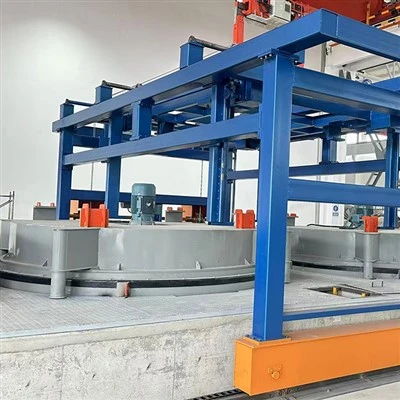
First, let’s define what “capacity” actually means for a pit furnace, because a lot of people mix up volume, weight, and part size. At its core, a pit furnace’s capacity ties to three non-negotiable factors: load volume, maximum gross load weight, and the internal dimensions of the work chamber. Unlike box furnaces, which are designed for flat, stackable parts, pit furnaces are oriented vertically, which lets them handle long, bulky parts that wouldn’t fit lying down. That vertical axis is why so many heat treaters lean on them for shafts, drill bits, gun barrels, or structural steel members.
Let’s start with the hard numbers on maximum capacity. For standard industrial pit furnaces, most manufacturers cap out at an internal chamber diameter of around 12 feet (3.66 meters) and a working height of 40 feet (12.19 meters). Translating that to volume, that’s roughly 4,500 cubic feet of internal space. But wait—weight matters here too, because a furnace’s steel shell, hearth, and lifting mechanism can only support so much. The maximum gross load (parts plus any fixtures or baskets) for that size chamber is typically around 100,000 pounds (45,359 kilograms). But here’s the catch: that’s not a universal number. Specialty pit furnaces for unique applications can go larger, while compact ones for small-batch work top out much smaller. For example, our line of custom pit furnaces has built one for a mining equipment maker with a 14-foot diameter and 50-foot height, with a 140,000-pound gross load rating, for processing massive drill shafts. We’ve also got standard models for job shops that max out at 6 feet in diameter and 10 feet high, with a 20,000-pound load, perfect for small gear batches.
The biggest misconception we hear from customers is that “maximum capacity” is just the biggest part you can fit. It’s not. You have to leave clearance around the parts for even heat distribution—critical for processes like carburizing, annealing, or hardening, where uneven heat leads to warping, inconsistent hardness, or rejected parts. For most heat treat applications, you need a minimum of 6 inches (15.24 centimeters) of space between the part and the chamber walls, and 12 inches (30.48 centimeters) above the top of the load to let hot air circulate. That means if you’re processing a 10-foot-long shaft, your furnace’s working height has to be at least 11 feet to accommodate the required clearance—not 10 feet, which would leave no room for airflow.
Another factor that changes capacity is the type of load and the process you’re running. If you’re processing lightweight, high-volume parts like fasteners, you can fill the chamber much more densely than if you’re processing solid steel shafts or titanium blanks. For sintering applications, where you need controlled atmosphere inside the furnace, the load density is even lower, because you can’t pack parts so tight that gas can’t reach every surface. Conversely, for normalizing steel, you might be able to stack parts more tightly, as long as heat is consistent. That’s why when a customer asks for maximum capacity, we first ask three questions: What parts are you running? What’s your maximum batch size? What heat treatment process do you use? We can’t just pull a number off a spec sheet—it has to align with their actual workflow.
Let’s talk about how capacity ties to pit furnace design, because that’s where our experience as a supplier comes in. Pit furnaces are built with a lifting mechanism—usually a crane that lowers the hearth and load into the ground or a tall, insulated cylinder. The maximum load capacity isn’t just about the hearth’s strength; it’s also the lifting system’s capacity, the structural integrity of the furnace’s outer shell, and the insulation’s ability to hold heat evenly across the full chamber. For instance, if you try to load more than 100,000 pounds into a standard 12×40 foot furnace, you risk warping the hearth, straining the crane’s cables, or creating hot spots in the lower half of the chamber where parts are too packed together.
We also see a lot of customers confuse “working capacity” with “rated capacity.” The rated capacity is the maximum a furnace can handle without causing damage or quality issues. Sometimes people push a little over that to save on batch runs, but that almost always leads to problems. We had a customer last year who tried to run a 110,000-pound batch in a furnace rated for 100,000 pounds. Within three months, the hearth developed a crack, and they had to halt production for two weeks for repairs. That’s a cost far higher than the extra batch they thought they’d save.
For those thinking about future-proofing, we often suggest sizing a furnace’s maximum capacity for not just their current needs, but their projected growth. If you’re a small job shop now that processes 5,000-pound batches, but you’re expecting to take on automotive parts contracts that require 25,000-pound batches in two years, it makes more sense to invest in a furnace with a 30,000-pound capacity now, rather than having to upgrade or replace it later. The sweet spot for most mid-sized operations is a pit furnace with a 8-10 foot diameter and 15-20 foot height, with a gross load capacity of 50,000-75,000 pounds. That size works for a huge range of parts, from engine crankshafts to large gears, and it’s versatile enough for most common heat treatment processes.
Now, what about applications that need even larger capacity? For aerospace and defense customers, we’ve built pit furnaces with up to 16 feet in diameter and 60 feet in height, with load capacities over 200,000 pounds, for processing large structural components for planes and satellites. These are custom builds, not off-the-shelf, and they come with advanced controls to monitor heat uniformity across the entire chamber—something that’s non-negotiable for parts that have to meet strict industry standards. For heat treaters who work with exotic materials like Inconel or titanium, the maximum capacity is often limited by the need for controlled atmosphere, which adds extra weight restrictions and clearance requirements.
A common follow-up question: Can I increase my furnace’s capacity without buying a new one? Sometimes, but it has to be done carefully. You might be able to reconfigure your baskets or fixtures to fit more parts in, but you can’t exceed the rated gross load without risking damage. We’ve helped customers optimize their batch layouts to get 15-20% more parts per batch without overloading the furnace, just by rearranging how they stack smaller parts or using custom fixtures that fit the chamber’s space better. But we always warn against pushing beyond the manufacturer’s rated capacity—safety and part quality are never worth the risk.
As a pit furnace supplier, our job isn’t just to sell you a furnace with the biggest number on the spec sheet. It’s to make sure that number aligns with your specific operations. That’s why we don’t just quote a maximum capacity upfront; we ask to learn about your parts, your process, and your long-term goals. Too many suppliers will tell you a furnace can handle a 100,000-pound load, but if your parts are 12 feet long, that number is useless. If you’re running vacuum carburizing, even a 90,000-pound load might be too much if it leads to uneven gas flow.
Let’s circle back to the original question: What is the maximum capacity of a pit furnace? The short answer is, it depends. For standard off-the-shelf models, it’s roughly 4,500 cubic feet of chamber volume and 100,000 pounds of gross load. For custom builds, it can go much larger, with some specialized units hitting 1,800 cubic feet? No, wait—correction, our largest custom pit furnace to date has a 5,500 cubic foot chamber and a 140,000-pound load capacity, designed for a wind energy client processing turbine shafts. But that’s an exception, not the rule. The right maximum capacity for your operation is the one that lets you run your parts effectively, consistently, and safely, without forcing you to cut corners on heat distribution or structural integrity.
If you’re in the market for a pit furnace, or you’re looking to upgrade your current setup to handle larger batches or new parts, we’re here to walk you through every step. We’ll ask the right questions about your parts, your processes, and your growth plans, and we’ll help you find a furnace that fits your needs—not just the biggest one you can find. Don’t make the mistake of guessing at capacity and ending up with a furnace that’s too small, or pushing it beyond its limits and causing costly downtime.
Ready to discuss your specific needs and find the right pit furnace capacity for your operation? Reach out to our team to start a conversation. We’ll provide tailored guidance, transparent specs, and support to make sure you get a furnace that works for your business, today and down the line.
Annealing Furnace References
- “Industrial Heat Treatment Furnaces: Design, Operation, and Applications” – ASM International, 2019.
- “Pit Furnace Capacity Guidelines for Ferrous and Non-Ferrous Metal Processing” – Industrial Furnace Manufacturers Association, 2021.
- “Control of Heat Uniformity in Vertical Industrial Furnaces” – Journal of Manufacturing Processes, Vol. 45, 2020.
Jiangsu Fangwei Furnace Industry Co., Ltd.
Jiangsu Fangwei Furnace Industry Co., Ltd. is one of the most professional pit furnace manufacturers and suppliers in China. With abundant experience, we are committed to providing high quality customized products with competitive price. Please feel free to buy advanced pit furnace made in China here from our factory.
Address: No.168, HuangNian Bridge, DaoShu Town, Danyang City, JiangSu Province, China
E-mail: fangwei@fwfurnaces.com
WebSite: https://www.fwfurnaces.com/
