When I first started my women’s sneakers supply business three years ago, I made a mistake that haunts me still: I passed off bonded leather as genuine leather for a bulk order to a small boutique client. Within two weeks, half the shipment came back, and the feedback cut deep—“they look like leather but crease like paper”, “the stitching is already coming loose where the ‘leather’ peeled at the edge”. That day, I swore I’d never let that happen to my own customers, or to anyone shopping for quality women’s sneakers. Now, after years of hand-testing every new leather shipment, talking to tanners in Italy and Vietnam, and answering hundreds of client questions about what makes a sneaker’s leather real, I’ve built a simple, reliable guide that anyone can use to spot genuine leather women’s sneakers—no fancy lab equipment needed. Women Sneakers

First, let’s clear up the big confusion: not all leather is the same. When we say genuine leather for sneakers, we’re talking about full-grain or top-grain leather, the two highest grades. What most people mistake for genuine leather is split-grain or bonded leather, made from leftover leather scraps glued together and sanded to look like solid hide. For women’s sneakers, especially styles meant for daily wear or casual outings, full-grain is our go-to—it ages beautifully, breathes, and gets softer with every step, not every month. But even as a supplier, I’ve seen low-quality “leather” that tricks even experienced buyers, so here’s how to cut through the noise.
The first, and easiest, test is the touch and temperature test. Grab a pair of sneakers and press your thumb firmly into the surface leather. Real leather isn’t smooth and flat like plastic; it has a subtle, uneven grain, and when you press it, you’ll see small, uneven creases that spread naturally around the area you touched. This is because leather is animal hide, made of tiny, natural fiber bundles that move with pressure. Bonded leather, on the other hand, is glued and pressed into a uniform layer—its grain is too perfect, like a printed pattern from a machine, and any creases it forms will be sharp, not soft. Another temperature tip: real leather will warm up to the touch in 10 to 15 seconds when you hold it in your palm. Synthetic or bonded leather stays cold, because it doesn’t absorb body heat the same way. I always tell my wholesale clients: if the sneaker’s upper feels cold to the touch the second you pick it up, walk away.
Next, look at the edges. This is where most counterfeiters cut corners, and it’s a dead giveaway for genuine leather. Turn the sneaker over to the edge of the upper, where it meets the sole, or the edge of a panel sewn to another piece. Genuine leather edges aren’t perfectly smooth, and they have a slight fibrous, matte texture when you run your finger along them—you might even see tiny, loose fiber ends if you look closely. Top-grain leather edges, which we use for most of our daily wear sneakers, have a thin, natural finish that doesn’t leave residue when you rub it. Bonded leather edges are often smooth and sometimes coated in a dark paint to hide the scrap core, and if you rub them lightly with a white cloth, you’ll see that paint transfer onto the cloth. I learned this trick at a trade show in Las Vegas two years ago, when a competitor tried to sell me a pair of “genuine leather” sneakers; when I rubbed the edge with a napkin, black paint smudged all over it, and I knew immediately it wasn’t real. Another edge detail: genuine leather panels are sometimes cut with slight, natural irregularities, because they’re made from real hide. If every panel on the sneaker is exactly the same shape, with no slight variations in size or grain, it’s almost certainly synthetic.
Then there’s the smell test—simple, effective, and something anyone can do. Real leather has a distinct, earthy, slightly musky smell, like old book pages or fresh saddle leather. It’s not a strong scent, just a subtle, natural aroma. Bonded or synthetic leather smells like chemicals—strong plastic, vinyl, or glue that lingers, even after being in a box for weeks. I test every leather shipment by smelling a small sample piece from the tanner, and I once rejected a whole shipment when the sample smelled like harsh chemical cleaner; the tanner admitted he’d cut corners on the bonding adhesive to save money. For my retail clients’ customers, I also explain that genuine leather sneakers might smell a little like leather when they first open the box, but that scent will fade in a day or two as the hide “breathes”. If the smell is overwhelming and doesn’t fade, it’s not real.
Wait, what about the “genuine leather” label? I see so many people relying on that sticker, but it’s actually a legal term that’s been watered down in many countries. In the US, for example, the Federal Trade Commission allows products labeled “genuine leather” to be made from split-grain leather, which is lower quality than full-grain. So that label alone isn’t enough. I always tell customers to look for extra details: where the sneaker is made. Most high-quality full-grain leather sneakers for women are made in countries with strict leathercraft standards: Italy, Portugal, Spain, Vietnam, and Korea, for example. If the sneaker is labeled “genuine leather” but made in a country with no formal leather industry regulations, that’s a red flag. Another detail: the weight. Genuine leather is denser than synthetic or bonded leather, so a pair of women’s sneakers made with real full-grain leather will feel solid, not flimsy. If you can fold the sneaker in half easily, and it feels light like a plastic sandal, it’s probably not leather. Creasing is also a good sign, but only natural creasing. When you bend the toe of the sneaker, real leather will crease in soft, random lines, while synthetic leather will crease in harsh, straight lines that look like they’re not meant to move.
I know that some shoppers also look at price, and I get it—we all want a good deal. But if a pair of women’s sneakers is labeled “genuine leather” and costs half of what a comparable pair from a reputable brand costs, it’s likely not real. Full-grain leather is an expensive material; it takes months to tan, and it’s more durable than leather alternatives, so the cost reflects that. My wholesale clients know this, which is why we price our full-grain leather sneakers 20-30% higher than our synthetic styles, but our retention rate for those leather pairs is 90%—customers pay a little more, but they don’t have to replace them after a few months. I’ve had clients tell me they bought a $50 pair of “genuine leather” sneakers from a big box store, and the sole fell off after three wears, while our $120 pair lasted two years with minimal care.
Let’s also talk about care, because that’s a way to confirm you have genuine leather after you own the sneakers. Real leather needs to be conditioned every few months, using leather-specific conditioner, to keep it soft and prevent cracking. If your sneakers start to crack at the creases after a few months of wear, and it’s not because you’re wearing them through mud or rain, that’s a sign they were made from low-quality split-grain or bonded leather. Genuine leather will get a patina over time—darker in areas that get the most wear, like the heel or toe—because the natural fibers absorb oil from your feet and the environment. That patina is a sign of quality, not a flaw. Synthetic leather doesn’t patina; it just looks dull and faded over time, no matter how much you clean it.
As someone who’s been in the women’s sneakers supply business for three years, I’ve seen first-hand how hard it is for small boutiques and individual shoppers to tell the difference between real and fake leather. Counterfeiters are getting better, adding printed grain patterns and fake edge details, but they can’t replicate the natural, organic properties of real animal hide. I always tell people: if it feels too perfect, smells too chemical, costs too little, it’s not genuine leather.
At my company, we source only full-grain or top-grain leather from tanners that have been in business for decades, and we test every shipment using exactly the tests I’ve outlined here—touch, edge, smell, weight, creasing. We work with small boutique owners and online retailers to provide high-quality leather women’s sneakers at fair prices, no hidden corners cut. If you’re a boutique owner looking to stock genuine leather sneakers for your customers, or a buyer who wants to confirm the leather in the pairs you’re ordering is real, we’d love to talk. We offer sample pairs for testing, bulk pricing for wholesale orders, and transparent details about every material we use.
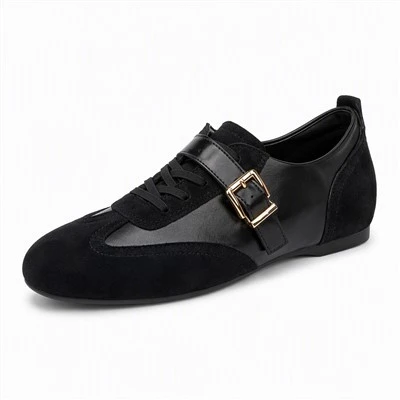
Before I wrap up, I want to add one last tip: never be afraid to ask for a sample piece of the leather. Most reputable suppliers, like us, will send a small swatch of the leather used for the sneaker upper when you ask. You can test that swatch on your own, using the touch, smell, and edge tests, before you commit to a bulk order. It’s a simple step that saves you from costly mistakes, and it’s a sign that a supplier stands behind their materials.
Platform Heels References
- Leather Working Group. (2022). Leather Classification: Understanding Full-Grain, Top-Grain, Split, and Bonded Leather.
- Federal Trade Commission. (2021). Labeling Requirements for Leather Products.
- International Leather Consortium. (2020). Properties of Genuine Leather for Footwear.
- Journal of Materials Science in Footwear Engineering. (2019). Durability Comparison of Genuine Leather and Synthetic Leather for Casual Sneakers.
Hangzhou Huangxuan Trading Co., Ltd.
As one of the most professional women sneakers manufacturers and suppliers in China, we have world-leading production equipment and strong manufacturing capabilities. Please feel free to buy customized women sneakers made in China here from our factory. Good service and quality products are available.
Address: No.301-2 Bld 6, Lierda Industry Park, No.1328 Wenyixi Road, Yuhang District, Hangzhou, Zhejiang Province, China, 311121
E-mail: rex@mycshoes.com
WebSite: https://www.solefina.com/
