If you’ve ever walked a construction site, a warehouse with high mezzanines, or an outdoor maintenance yard, you’ve probably seen a scissor lift: that familiar, steel-framed platform that folds up like a set of crossed scissors to reach heights too high for ladders. But when someone mentions an “electric rough terrain scissor lift,” it’s not just another name for that machine. As a scissor lift supplier who’s worked with these units for over a decade, I’ve talked to dozens of operators, site managers, and equipment buyers who mix up electric rough terrain scissor lifts with indoor models or diesel-powered rough terrain lifts—so let’s break this down clearly, how they work, what makes them unique, and when they’re the right choice for your job. Scissor Lift
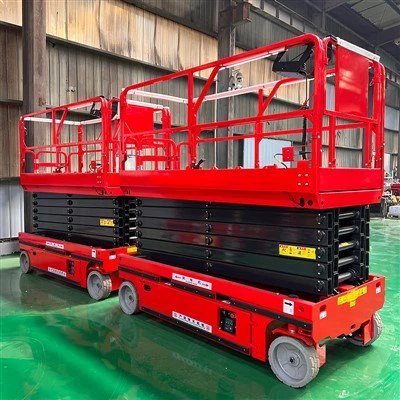
First, let’s start with the basics of a scissor lift, in general, to set context. A standard scissor lift is a type of aerial work platform (AWP) designed to lift workers, tools, and small materials vertically to perform tasks at height. The “scissors” are the crisscrossing steel arms that extend and retract; when hydraulic fluid is pumped through the scissor linkage, the arms push upward, lifting the platform and its load. They’re preferred over ladders or scaffolding for most jobs because they’re faster to set up, more stable, and can carry more weight than a single worker climbing a ladder.
Now, the two key modifiers here are “electric” and “rough terrain.” Most people know electric scissor lifts as the ones you see inside retail stores, offices, or warehouses—they’re quiet, low-emission, and designed for smooth concrete or asphalt surfaces. But rough terrain scissor lifts are built for uneven, unpaved ground: dirt, gravel, grass, or even muddy work sites. The electric version of this model combines that rugged off-road design with an electric power source, and that balance is what makes it such a game-changer for many outdoor job sites.
Let’s dive into what makes a rough terrain scissor lift different from its indoor cousin. First, the chassis and undercarriage. Indoor electric scissor lifts have thin, smooth tires and a lightweight frame, since they only need to navigate flat, paved floors. Rough terrain models have thick, deep-treaded rubber tires—think off-road ATV tires—not the thin tires of a consumer lawnmower, but heavy-duty units that can grip loose dirt or small rocks. The undercarriage is higher too: most indoor lifts have a ground clearance of 2 to 4 inches, but electric rough terrain scissor lifts sit 8 to 12 inches off the ground, so they can clear small bumps, ruts, or debris without getting stuck.
Next, the power source. Unlike diesel-powered rough terrain lifts, which rely on internal combustion engines for torque and speed on uneven ground, electric rough terrain scissor lifts run on rechargeable lithium-ion or lead-acid batteries. That’s a big deal for two reasons: first, electric motors are far quieter than diesel engines, so if you’re working near a residential neighborhood, a school, or an office building where noise rules apply, an electric rough terrain lift won’t draw complaints from nearby workers or residents. Second, they produce zero exhaust emissions—no fumes, no carbon monoxide, no unburned fuel. That makes them ideal for enclosed outdoor spaces, too, like a large warehouse yard with a loading bay that’s partially covered, or a construction site near a tunnel entrance where ventilation is limited.
Wait, but what about the downside of electric power? Some people think electric rough terrain lifts don’t have enough power for steep slopes or heavy loads. Modern units fix that: most top electric rough terrain scissor lifts have a gradeability (ability to climb slopes) of 20 to 30 percent, meaning they can handle hills up to 30 degrees—steeper than most residential driveways, and enough for even uneven construction site access roads. They also have load capacities: most models can carry 500 to 1,000 pounds, which is enough for two workers plus tools, a big difference from small indoor scissor lifts that only hold 500 pounds for one worker.
Now, let’s talk about how electric rough terrain scissor lifts work, step by step, to give you a clear picture. When an operator turns the key, the battery sends power to the hydraulic pump, which pushes fluid through the scissor arms’ cylinders. The operator controls the lift using a hand-held controller at the platform or the base: to move up, they engage the pump; to move down, they release pressure. For ground travel, the electric motor powers the wheels, which are geared for torque to handle uneven ground. Most models also have four-wheel drive, not just two, so if one wheel hits a rut, the others pull the lift forward without getting stuck. A lot of people ask about stability: rough terrain lifts have a lower center of gravity than boom lifts, because the scissor arms are stacked vertically, not extended outward. That makes them more stable on uneven ground, as long as the operator follows the manufacturer’s rules (no overloading, no operating on slopes steeper than rated, no leaning off the platform).
Who uses electric rough terrain scissor lifts, and when? Let’s go through the most common applications. First, general construction: if you’re building a residential subdivision, an electric rough terrain lift is perfect for installing gutters, trimming tree branches, or fixing siding on houses that sit on dirt or gravel lots. Unlike a diesel lift, you can run it early in the morning without waking up nearby homeowners, and you don’t have to worry about exhaust fumes seeping into open home windows. Second, facility maintenance for large outdoor sites: think a college campus with tall light poles, a factory’s outdoor storage yard, or a park with a large amphitheater. These sites have uneven ground, and noise rules mean you can’t use loud diesel equipment, so electric rough terrain lifts are the standard. Third, event setup: if you’re building a stage for a outdoor music festival, or hanging string lights for a fair, the ground might be grass or gravel, and you need equipment that’s easy to move quietly without damaging the venue.
Now, let’s compare electric rough terrain scissor lifts to other types of lifts, to clarify why they’re not just a “rough terrain lift with a battery.” Diesel rough terrain scissor lifts are more powerful for very heavy loads or very steep slopes—if you’re moving 1,000 pounds of brick up a 30-degree hill, a diesel model might be a better fit. But they’re louder (75 to 85 decibels, about as loud as a lawnmower) and produce emissions, so they can’t be used in many residential or semi-enclosed areas. Boom lifts, another common aerial work platform, have articulated arms that can reach around obstacles, but they’re more expensive, harder to transport, and less stable on uneven ground than scissor lifts. Electric indoor scissor lifts are great for flat surfaces, but if you drive them over a small rock, they’ll jolt and can even tip—something electric rough terrain lifts are built to handle.
One question I get all the time: how much do electric rough terrain scissor lifts cost, and what about maintenance? As a supplier, I can tell you that the upfront cost is usually a bit higher than a diesel rough terrain lift of the same height, but the long-term savings are huge. Electric motors have fewer moving parts than diesel engines, so there’s less to maintain: no oil changes, no fuel filters, no spark plugs. You just need to check the battery regularly, keep the tires inflated, and clean the scissor arms to prevent rust. Operating costs are lower too: electricity is cheaper than diesel, and you don’t have to pay for fuel or disposal of waste oil. For a model that works 50 hours a week, the average operator saves $1,500 to $2,000 a year on fuel and maintenance with an electric model.
I’ve also seen a lot of operators worry about battery life, and that’s a valid concern for any electric equipment. Modern lithium-ion batteries, which are standard on most new electric rough terrain scissor lifts, last 8 to 12 hours on a single charge, which is enough for a full workday. If you need more run time, some models have swappable batteries, so you can swap in a fully charged one during your lunch break without shutting down the site. Lead-acid batteries, which are still used on some budget models, last 4 to 6 hours, and need to be charged overnight, but they’re cheaper upfront.
Now, let’s talk about what to look for if you’re in the market for an electric rough terrain scissor lift, as someone who’s helped hundreds of clients choose the right unit. First, height: not just the platform height, but the maximum working height. Most models have a platform height of 19 to 50 feet, so you can calculate the height you need by adding 6 to 8 feet to the platform height (since you’re standing on the platform). Second, load capacity: make sure it’s enough for your workers and tools. If you’re two workers, you’ll need at least 1,000 pounds of capacity. Third, ground clearance and tire size: if your site has deep ruts or large rocks, look for a model with 10 inches or more of ground clearance, and deep-tread tires for traction. Fourth, noise rating: if you’re working near residential or commercial buildings, look for a model with a noise level under 70 decibels, which is quiet enough to talk over without raising your voice.
I’ve seen too many site managers make the mistake of choosing the wrong lift for the job: buying a cheap indoor scissor lift and trying to use it on a construction site with dirt lots, only to have it get stuck or damaged. Or buying a diesel rough terrain lift for a job near a school, getting a noise complaint and having to shut down work. That’s why understanding what an electric rough terrain scissor lift is, and what it’s designed for, is so important. It’s not just a middle-of-the-road option—it’s a specialized machine that balances the ruggedness of off-road equipment with the quiet, low-emission benefits of electric power.
At the end of the day, the right aerial work platform depends on your specific job, but electric rough terrain scissor lifts fill a unique niche that no other lift can. They’re versatile enough for uneven ground, quiet enough for residential and urban areas, efficient enough to save you money on operating costs, and stable enough to keep your workers safe. If you’re planning a project that involves working at height on unpaved or semi-enclosed sites, or if you’re tired of the noise and emissions of diesel equipment, an electric rough terrain scissor lift is worth your consideration.

If you’re ready to learn more about which electric rough terrain scissor lift fits your project, or to discuss rental and purchase options, we’re here to help. Reach out to us to schedule a consultation, ask questions about specifications, or request a demo of our units so you can see how they perform on your worksite.
Single Mast Aluminum Alloy Lift References
- Occupational Safety and Health Administration (OSHA). Aerial Lift Standards for Construction.
- International Organization for Standardization (ISO). ISO 18878:2019, Earth-moving machinery — Mobile elevated work platforms — Safety requirements.
- Association of Equipment Manufacturers (AEM). Electric Aerial Work Platforms: Market and Performance Report.
- National Institute for Occupational Safety and Health (NIOSH). Safe Operation of Rough Terrain Aerial Work Platforms.
- Equipment World. 2023 Guide to Electric Rough Terrain Scissor Lifts: Benefits and Applications.
Shandong Zhongke Huali Machinery Co., Ltd.
As one of the most professional scissor lift manufacturers and suppliers in China, we also support customized service. We warmly welcome you to wholesale discount scissor lift in stock here from our factory. For price consultation, contact us.
Address: No. 2 Qubai Road, Qudi Street, Jiyang District, Jinan City, Shandong Province
E-mail: yonghuiai@hualizgjx.com
WebSite: https://www.hualiheavy.com/
