If you’ve ever walked into a tile shop, admired a perfectly polished kitchen countertop, or even noticed how smoothly a concrete floor transitions from one room to the next, you’ve probably interacted with the end result of a stone grinding disc. But how many of us stop to wonder: what exactly is the grinding precision of these tools, and why does it matter for the projects that depend on them? As a supplier who’s spent 12 years sourcing, testing, and selling these discs to contractors, fabricators, and DIYers alike, I’ve seen firsthand how a disc’s precision can make or break a job—from a $500 residential bathroom remodel to a multi-million dollar commercial plaza project. Stone Grinding Disc
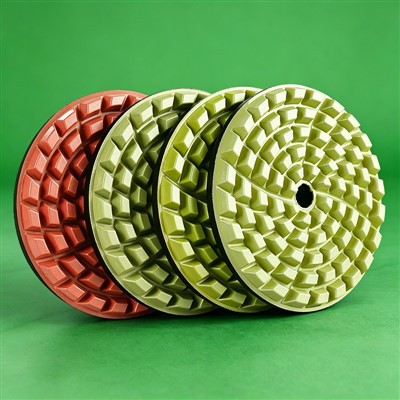
Let’s start with the basics that aren’t always clear to people new to the stone industry. Grinding precision for a stone disc is most often measured in microns, a unit so small that one micron is equal to one-thousandth of a millimeter. To put that in perspective, a single human hair is about 70 to 100 microns thick. That means a high-precision stone grinding disc can remove material in layers thinner than a human hair, while a lower-precision disc might remove material in layers closer to 50 microns or more. But precision isn’t just about how small a cut a disc can make—it’s also about consistency across the entire surface of the disc and how evenly it performs when it’s spinning at high speeds on a grinder.
Early in my career, I made a mistake that taught me just how critical this consistency is. I sold a batch of 10 resin-bonded grinding discs to a small tile installer who was working on a custom marble fireplace. He came back to me a week later, frustrated, saying some discs left a smooth, even finish while others had rough, uneven patches across the marble. When I tested those same discs in our warehouse, I found that the abrasive grains on the surface weren’t evenly distributed—some areas had clusters of grains that cut too deep, others had gaps that left no material removed at all. That batch had a precision variation of around 20 microns across its surface, which might sound small, but on a 2-foot wide fireplace surround, that translated to noticeable streaks that took hours of extra work to fix. Since then, I’ve made it a point to only work with manufacturers that test every disc for surface uniformity, not just the grit size stamped on the side.
Grit size is often confused with precision, but they’re two separate things. Grit size refers to the size of the abrasive particles on the disc—higher numbers mean smaller particles, which is why a 3000-grit disc gives a much smoother finish than a 50-grit disc. But precision is about how consistently those particles are bonded to the disc and how evenly they’re spaced. A 50-grit disc with high precision will leave a rougher surface than a 300-grit disc, but it will cut evenly, without gouging or uneven wear. Conversely, a 300-grit disc with poor precision will leave inconsistent scratches, even if it’s technically a finer grit.
The precision of a stone grinding disc is defined by three key metrics, all of which I test before I bring any product into my inventory. The first is dimensional precision: how flat the disc’s surface is and how evenly it sits on the grinder. A disc that’s even just 0.1 millimeter warped will wobble when it spins, leading to uneven material removal. For commercial projects that require a perfectly flat surface, like terrazzo flooring that will be polished to a mirror finish, we only stock discs with dimensional tolerances of less than 0.05 millimeters. That might sound like overkill, but a wobbling disc will leave ridges in the floor that require additional grinding and waste material.
The second metric is abrasive grain distribution. As I learned with that fireplace incident, if grains are clustered too closely, they’ll remove too much material in one spot, and if there are too few grains, the disc will slide instead of cut. The ideal distribution is a uniform spread of grains, with no clusters larger than 10 microns across and no gaps larger than 20 microns. This ensures that every pass of the disc removes a consistent amount of material, whether you’re grinding a hard granite countertop or a soft limestone tile.
The third and final metric is wear precision, which refers to how evenly the disc wears down as you use it. A disc that wears unevenly will develop a concave or convex surface over time, which not only ruins the precision of your cuts but also puts extra strain on the grinder’s motor. For example, a good quality diamond grinding disc for concrete will maintain its flatness for 30 to 50 hours of use, with wear of less than 0.2 millimeters across the entire surface. A lower-quality disc might wear unevenly after just 10 hours, forcing you to replace it or spend time truing it up with a dressing tool.
So, what do these precision numbers mean for someone actually using a stone grinding disc? Let’s break it down by project type, because that’s where it becomes most practical. For small, residential projects like polishing a bathroom countertop, a disc with a precision of 15 to 20 microns is usually more than enough. These discs are affordable and easy to work with, and most DIYers or small contractors won’t notice the difference between that and a higher precision disc. But for larger projects that require a uniform finish across hundreds of square feet, like a retail store’s granite floor or a hotel’s lobby, you need a disc with a precision of less than 10 microns. The consistency ensures that every inch of the floor looks the same, without having to go back and re-grind spots that were missed or cut too deep.
Another area where precision matters a lot is when working on thin stone materials, like thin-set marble or quartz slabs. These materials are only a few millimeters thick, so a disc with even a small variation in precision can easily cut through too much material, leaving a weak, uneven edge. I once worked with a fabricator who was installing thin quartz countertops in a high-end kitchen. He used a low-precision disc to grind the edges, and ended up with several edges that were 0.5 millimeters thinner than intended. That required him to re-order slabs, which cost him thousands of dollars in material and downtime. Since then, he only uses our high-precision edge grinding discs, which have a dimensional tolerance of less than 0.03 millimeters, for thin stone jobs.
It’s also important to note that precision can vary by disc type. Resin-bonded discs, which are used for finishing and polishing, tend to have higher precision than metal-bonded discs, which are used for heavy grinding on hard materials like granite or concrete. Metal-bonded discs are designed to be more durable, so their precision is usually around 10 to 15 microns, while resin-bonded discs can have a precision as low as 5 microns. That makes sense, because resin-bonded discs are used for final finishing, where even small imperfections are visible, while metal-bonded discs are used for rough grinding, where removing material quickly is more important than the absolute finest finish.
I’ve seen a lot of customers underestimate the importance of precision, choosing the cheapest disc they can find without thinking about long-term costs. A $10 low-precision disc might seem like a good deal, but if it wears out unevenly or leaves a finish that requires extra work, you’ll end up spending more money in the long run. Our high-precision discs might cost 20 to 30% more, but they last longer, produce a better finish, and reduce the amount of time your crew spends on touch-up work. For example, a contractor I work with who does 100+ residential remodels a year told me that switching to our high-precision discs cut his total grinding time per job by about 15%, which added up to an extra 40 hours of work a year for his crew.
Testing precision is something I do every day, not just for our own inventory but also when we help customers troubleshoot problems. If a customer is complaining about uneven finishes, gouges, or premature disc wear, the first thing I check is the precision of the disc they’re using. I have a small surface plate and a micrometer in my warehouse, and I test every batch of discs when they arrive, before I even offer them to customers. That’s not something every supplier does, but for me, it’s non-negotiable. A disc that doesn’t meet my precision standards isn’t worth selling, even if it’s cheap.
There’s a common misconception that all stone grinding discs have consistent precision, but that’s simply not true. Manufacturing processes vary, and budget models often cut corners on abrasive distribution or dimensional accuracy. Some manufacturers use lower-quality diamonds or abrasives, which break down unevenly, leading to poor precision. Others skip the final inspection step, so discs with warped surfaces or uneven grain distribution make it to market. That’s why it’s so important to work with a supplier who tests their products and can explain the precision metrics to you, not just give you a grit size number.
So, how can you tell if a stone grinding disc has good precision, without testing it yourself? There are a few signs to look for. First, the disc should feel perfectly flat when you lay it on a level surface. If it rocks or wobbles when you press down on the edge, it has poor dimensional precision. Second, the surface of the disc should be uniform—no visible clusters of grains, no gaps, no uneven coloring. Third, a high-quality disc will be labeled with its precision range, not just its grit size. If a disc only has a grit size stamped on it, that’s a red flag that the manufacturer might not prioritize precision.
For anyone who works with stone every day, investing in high-precision grinding discs isn’t just a quality choice—it’s a business choice. The time saved, the reduced material waste, and the better customer reviews add up to a big difference in the long run. I’ve been in this industry long enough to know that a job that looks perfect will come back to you for referrals, while a job with uneven finishes will lead to lost business. That’s why I make it my job to supply discs that not only meet industry standards but exceed them, because I want my customers to succeed, not just make a quick sale.
If you’re working on a project and you want to make sure your stone grinding discs have the precision you need, whether it’s a small residential job or a large commercial project, don’t hesitate to reach out to discuss your requirements. We can help you choose the right disc for your material, your grinder, and the level of precision your project demands. Whether you’re a contractor, fabricator, or DIYer, having the right tools makes all the difference, and our team is here to help you get exactly what you need.
Metal Frankfurt Abrasive References
- American Society for Testing and Materials. Standard Test Method for Measuring Lapping Flatness of Precision Grinding Discs. ASTM International, 2021.
- Stone Fabricators & Manufacturers Association. Precision Specifications for Diamond Grinding Tools for Natural Stone. SFA International, 2022.
- International Organization for Standardization. Abrasive Grain Distribution and Wear Resistance for Bonded Grinding Discs. ISO 9001:2019, 2019.
Quanzhou Cheefung New Materials Co., Ltd.
As one of the most experienced stone grinding disc enterprises in China, we are able to meet the needs of the majority of our customers. Please feel free to wholesale advanced stone grinding disc made in China here from our factory. For price consultation, contact us.
Address: Jinshan Community, Licheng District, Quanzhou City, Fujian, China
E-mail: info@prostonetools.com
WebSite: https://www.prostonetools.com/
